
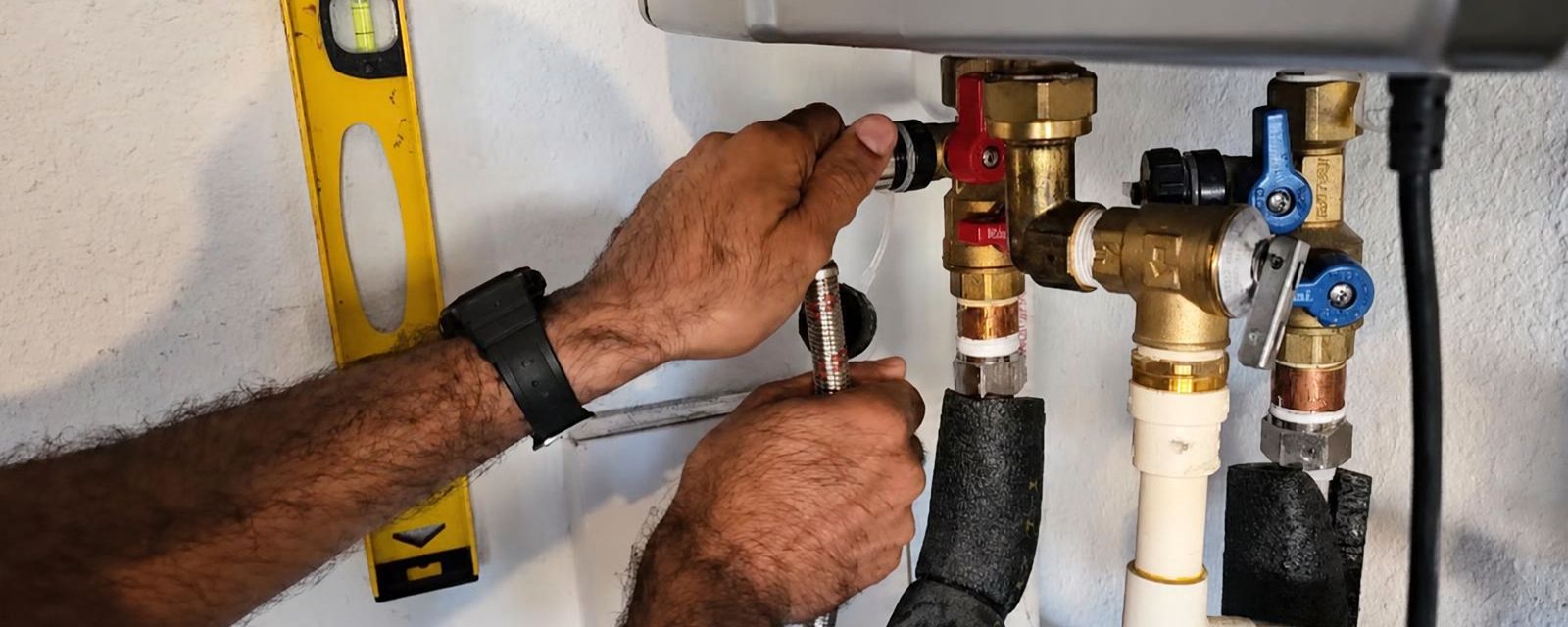
If Your Tankless Unit Is Leaking, Do This First
A leak near gas and electric components needs a careful response.
- Turn the unit off at its power switch or breaker.
- Close the gas valve to the unit and the cold water supply valve.
- Place a bucket under the drip and wipe any water from nearby electrical parts.
- If you smell gas, leave and call your gas utility from outside.
Where Tankless Leaks Come From
Loose or worn connections
The water and gas connections can loosen with vibration. A tightened fitting or a new washer fixes many leaks.
Isolation valves
These valves let you flush the unit. An O-ring or a cap may leak after a flush.
Condensate drain
On condensing models, a blocked condensate line drips acidic water.
Pressure relief valve
A valve that opens means pressure is too high.
A cracked heat exchanger
Water from inside the unit is the serious case. It often means replacement.
How Scale Leads to Leaks
Mineral scale builds up inside the heat exchanger and narrows the water path. The unit overheats in spots, the metal flexes, and over time a pinhole opens. A unit that has never been flushed is more likely to leak, so ask your installer for a flush schedule.
Hardness is not published in the Evans reports we reviewed, so test your water. If it is hard, a softener protects the unit between flushes.
Repair or Replace a Leaking Tankless Heater
Repair when
- The leak is at a fitting or valve.
- The unit is under ten years old.
- The heat exchanger is dry.
- A simple part solves it.
Replace when
- The heat exchanger is leaking.
- The unit is old and scaled.
- Repair cost approaches replacement.
- Parts are discontinued.
Know the model and error code?
Tell us when you call and we can say what is likely before we arrive.
What We Do When We Arrive
We find the source first, with the unit off and the water closed. If it is a fitting, we replace the washer or the valve and test it under pressure. If water is coming from the heat exchanger, we show you and explain the options.
We also check the venting and the gas supply, because a leaking unit may have other issues. See tankless water heater for our full service and water heater repair for tank units.
How to Prevent Tankless Leaks
Most tankless leaks are slow failures that give a warning. A drip at a valve, a stain under the unit or a smell of damp insulation all say something is loose or worn. Check the unit twice a year, looking at the bottom, the valves and the vent, and wipe it dry so a new drip shows.
Flush the unit on the schedule the maker suggests. Clean the inlet screen, which catches grit before it reaches the heat exchanger. If you hear popping or the water temperature swings, scale is probably forming, and a service call now costs less than a replacement later.
Warranty Questions to Ask Before You Call
Many tankless units carry a longer warranty on the heat exchanger than on other parts, and the terms often depend on how the unit was installed and maintained. Find the paperwork, note the date of installation and the model number, and take a photo of the leak.
Keep records of flushing and service. If a maker asks for proof of maintenance, a log with dates and a receipt is the best answer. We can document what we find so you have it if you make a claim.
Leak Location and What It Usually Means
Where the water appears often points to the cause. Use the table to guide the call to your plumber.
| Where you see water | Likely cause | Urgency |
|---|---|---|
| At a pipe connection | Loose fitting or worn washer | Shut off water, call soon. |
| At an isolation valve | Worn O-ring or cap after a flush | Shut off water, call soon. |
| From the condensate line | Blocked drain or neutralizer | Not urgent but needs service. |
| From the relief valve | High pressure or thermal expansion | Call promptly. |
| Inside the cabinet | Heat exchanger or internal failure | Shut everything off and call now. |
Documenting a Leak for an Insurance Claim
If water from a tankless unit has damaged the wall or floor, document it before you clean up. Take photos of the unit, the leak and the damage, note the date and time you found it, and keep any wet materials until the adjuster has seen them.
Ask the plumber for a written note on the cause and the repair. A claim for sudden damage goes more smoothly with a clear record, and the unit's age and maintenance history will matter too.
Tankless Leaks in Short
If you remember only a few things from this guide, remember these.
- Shut off power, gas and water before you look for the leak.
- Most leaks are at fittings and valves, and a few are in the heat exchanger.
- Flush the unit on schedule to prevent scale.
- Keep the paperwork and photos for the warranty and any claim.
Standards and Warranties for Tankless Units
Gas tankless heaters are installed under the maker's instructions and the International Fuel Gas Code (IFGC), and the water side follows the International Plumbing Code (IPC). Warranties generally depend on installation and maintenance that follow the maker's guidelines.
If a unit leaks, the guidelines for flushing and venting are the first things a maker will ask about, so keep the records.
Permits for Swapping a Tankless Unit in Evans
If your leaking tankless unit needs replacement, Evans requires a permit for water heater work. The city handles these through its One Stop service and says they are processed within 3 business days. A permit stays valid for 180 days. Start the permit early so you are not without hot water while paperwork waits.
We handle the permit as part of the replacement. If you are in Greeley, the same step applies, and you can find our service area on its own page.
Source: City of Evans permit pages