
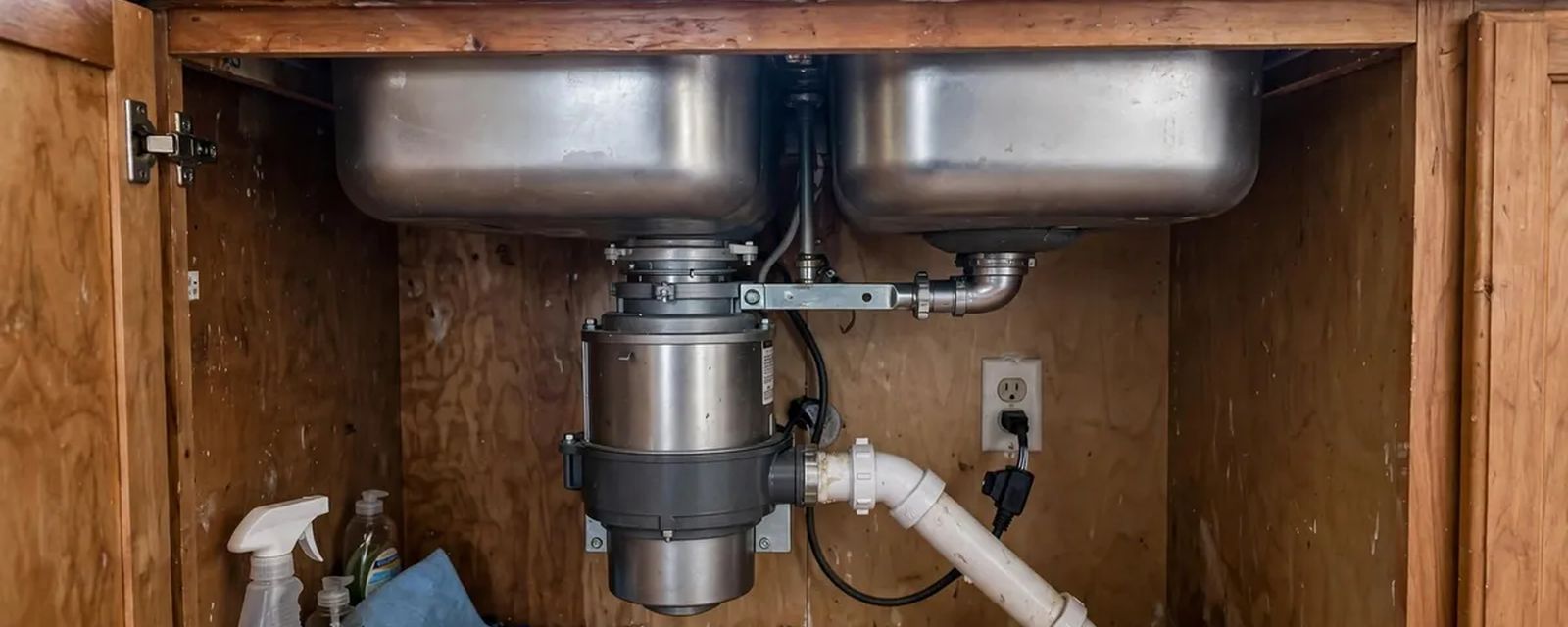
What You Need to Install a Disposal
The disposal itself comes with a mounting assembly, a gasket and an outlet for the drain. You will also need plumber's putty for the sink flange, a discharge tube, a drain tee or a continuous waste kit and a power connection. A dishwasher drain connection may also need a knockout removed.
Buy a disposal rated for your household. A larger motor handles more and runs quieter, and a small one jams more often. Check the manufacturer's instructions, because details differ between models.
Why a Double Sink Needs a Different Drain Layout
On a double sink, both bowls drain into a single trap. The disposal sits under one bowl, and its outlet has to connect to the same trap arm as the other bowl. That usually needs a continuous waste piece or a tee that joins the two drains before the trap.
The slope matters. The pipe must fall toward the wall at a steady slope so water and solids do not collect. A drain that runs flat or uphill leaves water in the pipe and causes slow drains and smells. If the old layout does not suit the disposal, we rebuild it.
The Install in Order
| Step | What happens | What to watch |
|---|---|---|
| Shut off and remove old parts | Close the water and power, remove the trap and old strainer | Place a bucket and keep parts together. |
| Mount the flange | Seat the sink flange with plumber's putty and fix the mounting ring | Tighten evenly so the seal does not leak. |
| Attach the disposal | Hang it on the mounting ring and lock it in place | Line up the outlet with the drain. |
| Connect the drain | Join the discharge to the tee or continuous waste and the trap | Check slope and fit. |
| Connect power | Wire or plug in the disposal on a proper circuit | Power off while wiring. |
| Test | Run water and check every joint, then run the disposal | Look for slow drains and drips. |
Not sure your sink drain will suit a disposal?
Send us a photo of the plumbing under your sink and we will tell you what it needs.
Mistakes That Cause Leaks and Slow Drains
Overtightening the flange
Cracks the gasket or the sink and starts a leak.
Forgetting the dishwasher knockout
If a dishwasher drains into the disposal, remove the plug or the dishwasher will not drain.
A flat or uphill drain
Water and solids sit and clog.
Using the wrong slip washers
Creates a drip at every joint.
Not using a grounded outlet
A safety risk. The unit needs proper power.
DIY or a Plumber
DIY is reasonable when
- You are replacing a disposal with a similar one.
- The sink and drain are in good shape.
- You are comfortable with plumbing and basic wiring.
- The power is already in place.
A plumber makes sense when
- The drain layout must change.
- There is no existing power or switch.
- The sink is stone or hard to work on.
- You want the work to carry a warranty.
Using the Disposal Without Causing Clogs
A disposal is for food scraps, not for grease, coffee grounds in bulk, bones, fibrous vegetables or anything not food. Run cold water before, during and for a short time after each use so the particles flush down the pipe.
Grease that goes down the sink cools and sticks to the pipe wall, and the disposal does not change that. Scrape pans into the trash. See garbage disposal repair for fixing a jammed unit, and drain cleaning if the line slows down afterward.
Choosing the Right Disposal for Your Household
A small household that cooks lightly can use a modest motor. A family that cooks often, or that wants quiet operation, will do better with a larger motor and better sound insulation. Continuous feed models run while the switch is on, and batch feed models run with the stopper in place for added safety.
Check the warranty and whether the maker sells replacement parts. A disposal with a jam-clearing feature and a corrosion-resistant chamber lasts longer than a bare-bones unit.
The Power Connection
A disposal needs a dedicated switch and a grounded outlet or a hardwired connection. Some models come with a cord, and some need one purchased. If there is no outlet under the sink, one must be added by a qualified person, and in many places that is permitted work.
Never run an extension cord to a disposal. If you are not sure about the wiring, have a plumber or an electrician handle it, and test the switch and the circuit before you finish.
Installing a Disposal in Short
If you remember only a few things from this guide, remember these.
- A double sink needs a drain layout that joins both bowls before the trap.
- Remove the dishwasher knockout if the dishwasher drains into the disposal.
- Do not overtighten the flange, and check the slope of the drain.
- Ask the city when a permit is needed, and keep the paperwork.
Code Notes for a Disposal on a Double Sink
The International Plumbing Code (IPC) requires a food waste disposer to discharge through a trap and be vented, and the National Electrical Code (NEC) requires grounding and a means to disconnect power. A double sink must also drain with a continuous slope to the trap arm.
According to the IPC, a trap must be accessible, which is why the layout under a disposal matters.
Permits and Paperwork in Evans
In Evans, work that alters plumbing or wiring may need a permit, and homeowners can submit permits by email. A permit is valid for 180 days. A simple swap of one disposal for another often falls under routine repair, but adding a disposal, moving a drain or adding a circuit is different. Ask the city if you are not sure, and keep the permit number for your records.
Evans has adopted the 2018 International Residential Code, so new work is held to that edition. We handle the permit when we install, and we serve Greeley as well, where the service area page lists nearby towns.
Source: City of Evans permit and building pages