
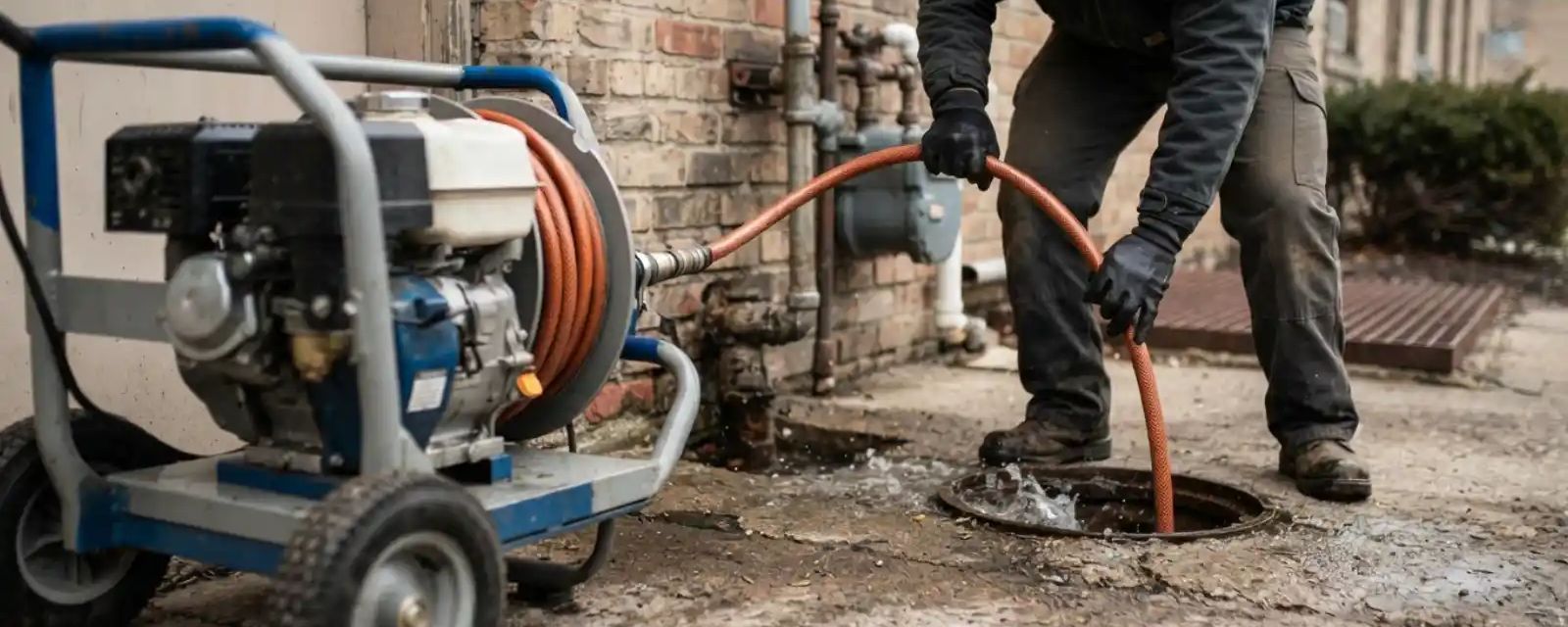
What a Hydro Jetter Actually Does
A jetter pumps water at very high pressure through a hose with a special nozzle. The nozzle fires jets backward to pull the hose forward and forward to scour the walls. The result is a full cleaning of the pipe, not just a hole through the clog.
A cable machine does the opposite. It breaks through a blockage and leaves most of the buildup on the wall. That is why a line that is cabled every few months usually has a coated wall that jetting would clear.
Lines That Benefit From Jetting
Grease-coated kitchen and restaurant lines
Fat hardens on the wall and catches everything that follows. Jetting clears it.
Lines with scale
Mineral and rust scale in older metal pipe narrows the bore.
Roots at a joint
Fine roots can be cut and flushed, but a broken pipe still needs repair.
Lines that clog again and again
Repeat clogs are a sign of buildup.
When Jetting Is the Wrong Choice
Jetting is risky for
- Collapsed or cracked pipe.
- Thin, corroded cast iron.
- Pipe with open joints.
- Lines of unknown condition with no camera.
Better first steps
- A camera inspection to see the pipe.
- A cable for a simple soft clog.
- Repair or lining for broken sections.
- A lower pressure setting for fragile pipe.
Why We Look Before We Jet
A camera shows the pipe material, the damage and the cause of the clog. Without it, jetting is a guess. With a break in the line, jetting can wash out soil around the pipe and create a void under your yard.
Ask any contractor whether they camera the line before and after. After the job, the footage proves the pipe is clean, and it gives you a record. Our sewer inspection service does just that, and the hydro jetting page covers our process in full.
Not sure your line can take a jetter?
Describe the pipe and the symptoms. We will say whether a camera should come first.
How to Vet a Contractor Before Paying for Jetting
Ask these questions. Is the company licensed, and can you check it? Do they use a camera? Do they explain the pressure setting for your pipe? Will they give you the price before they start? A contractor who cannot answer these is not ready to run a jetter in your yard.
Ask for a written scope that names the line, the access point and what is included. Beware of a flat deal that sounds too cheap, since it may skip the camera or quit early.
What to Do After a Line Is Jetted
A freshly jetted line is a clean slate, and the habits you keep decide how long it stays that way. Keep grease out of the kitchen sink, use strainers in showers and tubs, and flush only toilet paper. Wipes marked flushable do not break down, and they are one of the leading causes of repeat clogs.
If the camera showed roots at a joint, ask about the joint. Roots will return unless the opening is repaired. A short repair now is cheaper than repeated jetting for years, and your contractor should explain that trade-off honestly.
Why Jetting Prices Vary
Jetting is priced by the job, and the price depends on how much line there is to clean and how hard it is to get into. A short run through an outdoor cleanout is quick. A long main with heavy grease and no cleanout takes longer, and a camera before and after adds time but gives you proof.
Equipment matters too. A strong jetter and the right nozzles cost more to run than a small cable machine, but they finish the job. Ask for the price in writing before the work begins, and ask whether a second pass is included if the first does not clear the line.
Common Myths About Hydro Jetting
One myth is that jetting always damages pipe. On sound pipe it does not, and it is widely used on municipal lines. Another myth is that jetting is just a more expensive way to snake a drain. It does a different job, cleaning the wall instead of boring through the clog.
A third myth is that one jetting cures a line for good. It resets the line, and the result lasts as long as the cause stays away. A line with a belly or a bad joint will build up again. A good contractor tells you that before you pay.
Five Questions to Ask Before You Book
Ask what pressure the jetter uses and what nozzle will go in your pipe. Ask whether the crew will camera the line first. Ask what happens if the camera shows damage. Ask for the price in writing and for the footage afterward.
Jetting in Short
If you remember only a few things from this guide, remember these.
- Jetting cleans the pipe wall, while a cable only opens a hole.
- Camera the line first when the pipe age or condition is unknown.
- Ask what the contractor holds for a license, and whether they are a plumber or a drain cleaner.
- A clean line lasts as long as the cause, such as roots or a belly, stays away.
What the Plumbing Code Says About Drain Access
The International Plumbing Code (IPC) calls for cleanouts at set intervals along horizontal drains. A jetting hose goes in through a cleanout, and a line that lacks one is harder and riskier to clean.
According to the Colorado State Plumbing Board, drain cleaners are not regulated by the board, while plumbing contractors are licensed. Ask which one you are hiring.
Checking Credentials in Colorado and Evans
The Colorado State Plumbing Board, part of the DORA Division of Professions and Occupations, licenses plumbers, apprentices and plumbing contractors. It says it does not regulate drain cleaners, so a company that only cleans drains may not appear in its lookup. That means you should ask what license a contractor holds and whether they are a drain cleaner or a plumber. You can call the board at 303-894-7800.
Evans also requires every contractor to hold a current Evans business license, and plumbing contractors put state license numbers on permit applications. Ask for the Evans license before you sign, and for the state number if the job is more than a cleaning. We serve Greeley as well, and the service area page lists the rest.
Source: Colorado State Plumbing Board and City of Evans contractor pages