
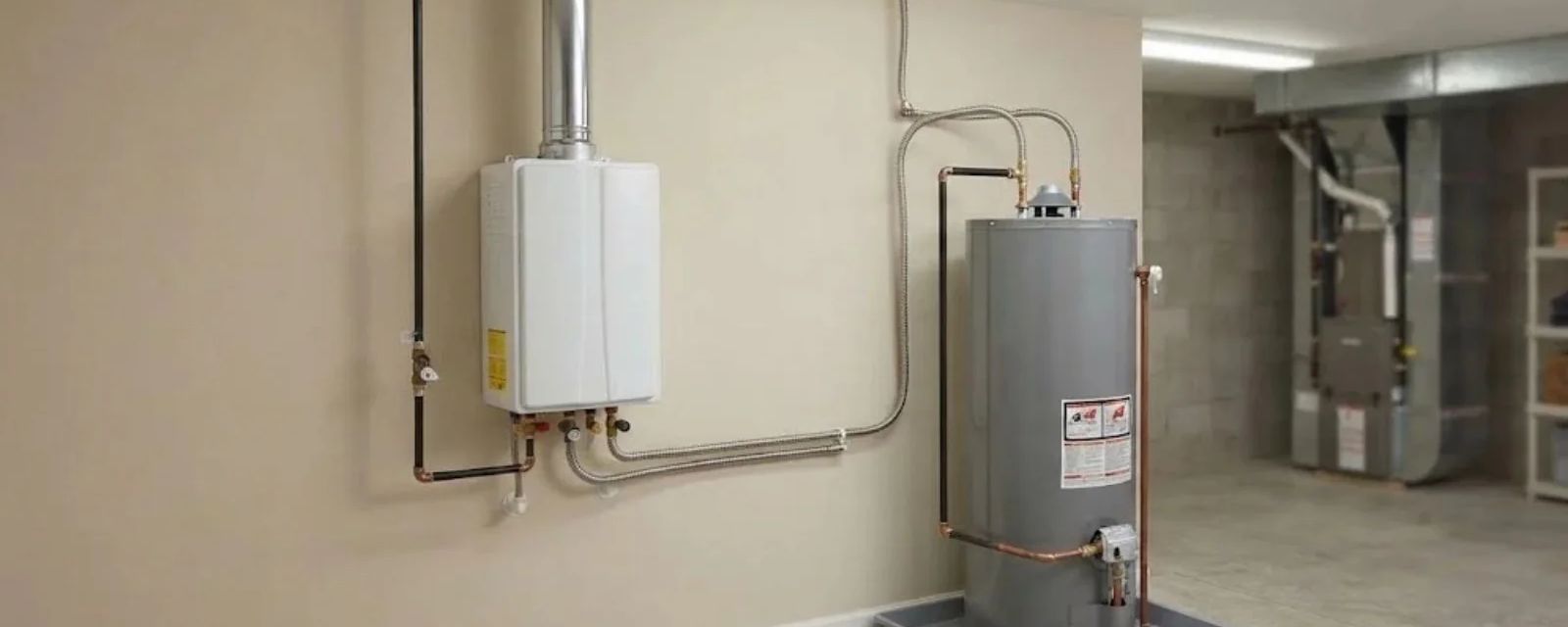
What the Vent Does and Why Mistakes Are Serious
A tankless heater burns a lot of gas in a small space, so it makes more exhaust per minute than a tank unit idling. The vent carries that exhaust and moisture outside. If the vent leaks, is blocked or terminates in the wrong place, exhaust can enter the house.
That is why vent work is checked at inspection and why the maker's manual carries strict rules. Treat the manual as part of the code, because inspectors do.
Common Vent Types for Gas Tankless Units
| Type | How it works | Notes |
|---|---|---|
| Direct vent, two pipes | One pipe brings air in and one sends exhaust out | Common on condensing units, uses approved plastic or stainless pipe. |
| Concentric vent | A pipe inside a pipe, air in and exhaust out together | Needs one wall or roof opening. |
| Power vent | A fan pushes exhaust through the pipe | Needs power and approved material. |
| Existing flue | Reuses an old chimney or flue | Often not suitable without a liner. |
Condensing and Non-Condensing Units Vent Differently
Condensing units
- Extract more heat, so exhaust is cooler.
- Can use plastic vent pipe in many models.
- Produce acidic condensate that must drain.
- Need a neutralizer in many installs.
Non-condensing units
- Exhaust is hot.
- Require stainless or approved metal vent.
- Produce little condensate.
- Usually cost less up front.
Length, Elbows and Slope
Every vent has a maximum equivalent length, and each elbow counts as extra length. Go over the limit and the unit may shut down, or run poorly and soot up. The manual gives the limit for each pipe size, and the installer must stay within it.
Slope matters on condensing units. The pipe must slope back toward the unit so condensate drains instead of pooling and dripping from joints. A long run with a sag is a common cause of leaks at the vent.
Planning a tankless install?
Call and we can talk through the venting route before you buy.
Venting Mistakes That Fail Inspection
Mixing pipe materials
Using a type of pipe the maker does not approve for the unit.
Termination in the wrong spot
Too close to a window, a door, a gas meter or another vent.
Missing supports and joints not sealed
Vent pipe must be supported and joints sealed per the manual.
Sharing a flue with another appliance
A tankless unit generally needs its own vent.
No condensate drain
Condensing units need a path and often a neutralizer.
Combustion Air and Carbon Monoxide Alarms
Gas units need air to burn. A unit in a tight closet may need an opening or a direct air pipe from outside. Without enough air, the flame burns poorly and produces more carbon monoxide.
Whatever the vent type, install carbon monoxide alarms on each floor and near sleeping areas. An alarm is a cheap backup to a good install. Test them monthly and replace them on the maker's schedule.
Replacing an Old Tank With a Tankless Unit
Many homes have a metal flue for the old tank, and that flue is rarely suitable for a tankless unit. It may be oversized, made of the wrong material or routed with a bend that does not suit the new exhaust. We usually plan new venting.
That often means running new pipe through a wall or the roof, which adds to the job. See tankless water heater for what the install includes, and water heater replacement if the old tank has already failed.
Questions to Answer Before You Buy a Unit
Before you buy, answer a few questions that decide whether a gas tankless heater fits. Where will the unit mount, and how far is that from an outside wall? Is there a gas line near, and what size is it? Does the route allow a vent to run to the outside without too many bends?
Write down the answers and share them with the installer. A vent run that is too long or has too many elbows may push you toward a different location or a different model, and it is much cheaper to learn that before the unit is on the shelf.
Keeping the Vent Safe Over the Years
A vent is not a set-and-forget part. Check the outdoor termination each season for nests, snow, ice or debris. A blocked terminal can cause the unit to shut down or burn badly, and in a snowy winter it is worth a look after every big storm.
Inspect the joints inside the house for stains or drips, which signal a leak of condensate or exhaust. Have the unit serviced on the maker's schedule, and ask the technician to check the vent as part of the visit. Do not reuse the vent from a failed unit on a new one without checking that it suits the new model.
Venting in Short
If you remember only a few things from this guide, remember these.
- Use only the vent type and length the maker lists for your model.
- Condensing units need a sloped vent and a condensate drain.
- A tankless unit generally needs its own vent, not the old tank flue.
- Install carbon monoxide alarms, and expect the vent to be inspected.
Where the Venting Rules Come From
Venting is governed by the International Fuel Gas Code (IFGC) and by the maker's installation instructions, which the code requires installers to follow. The instructions list approved vent materials, maximum lengths and clearances.
No generic guideline replaces the manual for your model, so keep it with the unit.
Which Code Edition Applies in Evans and in Greeley
Evans has adopted the 2018 International Plumbing Code, International Residential Code and International Fuel Gas Code. Greeley has adopted the 2021 International Code Council codes, including the Plumbing Code. The two cities are neighbors, yet the editions differ, so the same unit can be checked against different text depending on which side of the border the house sits on.
Tell us your address when you plan the install, and we follow the edition your inspector uses. We serve both, see emergency plumbing in Greeley and the service area page.
Source: City of Evans and City of Greeley building department pages